
Preloader

Email: pepax@pepax.sk

Phone: (+421) 911 642 601

— Sustainability, ESG and special areas

Design thinking and service design

We help organizations design products, services, and customer experiences based on real people's needs, not just internal assumptions. We connect research, co-creation, prototyping, and testing with processes, technologies, and business realities so that a good idea can be turned into a comprehensible and actionable service.

— Client situation and broader context

A good solution needs to understand both the person and the system in which it is to operate.

An organization can have a great idea, an experienced team, and a sufficient budget, and still create a service that people use differently than expected. Often, there is a lack of a thorough understanding of the user’s situation, the entire flow of their experience, and the operational conditions that enable or constrain the service.

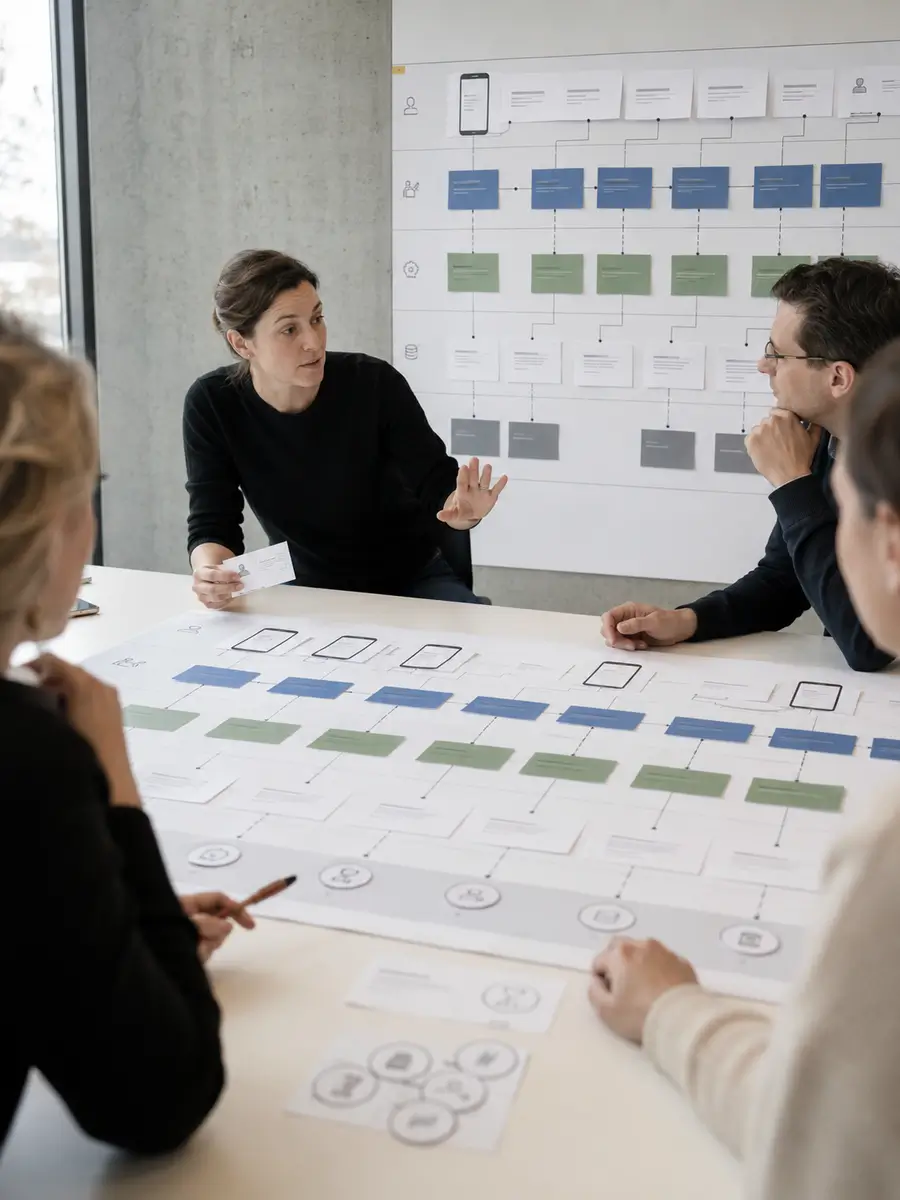
Design thinking helps to explore needs and transform findings into testable proposals. Service design expands the view of touchpoints, background processes, data, technology, roles, and rules

Odborník syntetizuje potreby používateľov a mapuje priebeh zákazníckej skúsenosti

People and their real situation

What a person needs to do, in what context they make decisions, and where uncertainty, effort, or mistrust arises.

The problem and its real cause

Research separates internal assumptions from needs that repeatedly manifest in the reality of users.

Experience along the way

The user perceives one process from first contact through use of the service to support or termination of the relationship.

Contact points and communication

The website, phone call, form, in-person meeting, product, invoice, and support create a shared experience.

Processes, roles and technologies

Frontstage and backstage must be designed as a single system that can reliably provide the service.

Feasibility and sustainable impact

The proposal must respect capacities, costs, risks, regulation, business model, and long-term impact.

— For whom and when is the service suitable?

When you need to verify the need before investing in a ready-made solution

The service is suitable for companies, public and non-profit organizations, product teams, service owners, HR, marketing, sales and transformation teams.

New product or service

Validation of target group, need, value and key assumptions before further development

Improving customer experience

Revealing ambiguities, repeated steps, varying contact quality, and complicated transitions between channels

Digitalization of the touchpoint

Moving or changing part of a service while maintaining clarity, accessibility, and continuity of the entire experience

Internal service for employees

Redesign of HR, IT, financial or other support services according to the needs of internal users

Comprehensive service with multiple owners

A common picture of the journey, roles, dependencies and responsibilities across departments, suppliers or institutions

Innovative or transformational intention

Comparing options based on user needs, feasibility, impact, and the organization's ability to implement the solution

— Value and possible shift

From internal ideas to a solution that can be demonstrated, verified and improved

Design thinking and service design do not guarantee that every idea will succeed. However, they help reduce uncertainty before investing in full development or large-scale change.

01

A more accurate understanding of needs

Decision-making can be based on observations, interviews, data, and recurring patterns.

02

A common picture of the customer journey

Teams will see the experience as a whole and recognize places of value, uncertainty, and unnecessary interruption.

03

Better focused innovation

Ideas are tied to specific needs and situations instead of internal enthusiasm without evidence.

04

Faster learning with less risk

A prototype will allow you to verify key assumptions before costly implementation.

05

Connecting experience and operations

The service blueprint will show what needs to happen in the processes, technologies, and background roles.

06

A clearer decision

The result may be continuation, modification of the concept, addition of research, or discontinuation of a poorly supported intention.

— Possible professional outputs

The outputs capture the needs, the form of the service and the conditions for its implementation.

A smaller assignment may yield a single map and a proven concept; a larger project may combine research, prototypes, a blueprint, and an implementation roadmap.

Research plan and synthesis of findings

Questions, stakeholder groups, resources, and a summary of recurring needs, barriers, and opportunities

Profiles of needs and situations

Work segments or scenarios based on findings, not the vague average person

Customer journey map

Experience stages, goals, touchpoints, questions, barriers and opportunities for improvement

Service blueprint

Connecting the visible experience to roles, systems, data, rules, and backend processes

Service concepts and prototypes

Simplified models of a future experience, process, communication, or touchpoint

Testing and implementation roadmap

Findings, recommended adjustments, priorities, owners, open questions and next steps
— How the cooperation works

From question and research to proven concept and realistic follow-up

Not every assignment requires all phases to be covered in the same depth. We will adjust the scope to the importance of the process, the available evidence, and the decisions that are to follow up on the output.

1. Introductory interview within 30 minutes

We will obtain basic information free of charge. This interview does not result in any professional analysis, recommendation or written output.

2. Challenge definition

We will clarify the users, uncertain assumptions, scope and decision that needs to be better informed

3. User and Context Research

We work with interviews, observation, data, feedback and available process documents.

4. Synthesis and path mapping

We organize the findings into needs, barriers, patterns and opportunities with decision-making significance

5. Co-creation, prototyping and testing

We will create options, prepare appropriate prototypes and validate them with relevant people

6. Blueprint and the path to implementation

We will complete processes, roles, systems, risks, priorities and recommended next steps

— What exactly does the service consist of?

Service modules are composed according to the level of uncertainty, scope of the service and development phase

Not every project needs a full methodological cycle. The modules are structured so that each activity helps answer a real decision-making question.

Tím prepája prototyp zákazníckeho kontaktu s procesmi a rolami na pozadí služby

1. Defining the design challenge

It identifies the problem, users, uncertainties, and the decision that the project is intended to support.

Contains: objective, scope, assumptions, constraints, success criteria and mandate.

2. User research

It brings knowledge of people, their situations, and the conditions of using or providing a service.

Contains: interviews, observation, feedback, research questions and collection of suggestions.

3. Synthesis of needs

It transforms individual findings into patterns, barriers and areas of opportunity.

Contains: classification, work segments, hypotheses and problem formulation.

4. Customer journey mapping

It depicts experience over time and reveals connections between contacts and outcomes.

Contains: phases, goals, steps, touchpoints, barriers and moments of truth.

5. Service blueprint

It connects the visible experience with everything the organization needs to provide behind the scenes.

Contains: frontstage, backstage, processes, roles, systems, data and dependencies.

6. Co-creation and concepts

It connects user, professional, operational and decision-making perspectives.

Contains: workshops, generation of options, criteria and selection of concepts.

7. Prototyping and testing

It allows you to showcase a future service before it is fully built.

Contains: storyboard, model, script, test plan, observation and iteration.

8. Implementation framework

It translates a proven concept into priorities, owners, and gradual implementation steps.

Contains: roadmap, pilots, capacities, risks, dependencies and metrics.

— What affects the price of this particular service?

The price is based on the scope of research, complexity of the service, and depth of verification.

0 €

Introductory interview

It serves to obtain basic information and verify the appropriate form of cooperation. It does not produce any professional analysis, recommendations or written output.

from €290

Minimum paid range

The specific scope may consist of a process consultation, background study, diagnostic block, workshop, or first agreed output.

We will confirm the specific price only after specifying the goal, scope, outputs and implementation conditions. Work beyond the agreed framework is carried out only after prior approval.

  1. Decision question and project phase.
  2. Number of target groups and segments.
  3. Accessibility for users and stakeholders.
  4. Scope and form of research.
  5. The complexity of the customer journey.
  6. Service blueprint depth.
  7. Number and difficulty of workshops.
  8. Level of the prototype being prepared.
  9. Number of test cycles and iterations.
  10. Scope of deliverables, deadline, language, travel and approved external costs.
— Regular monthly support

Continuity helps to keep user needs in mind even as the service gradually develops.

Monthly support can create a regular rhythm of research, design review, and decision-making so that the original intent is not lost during implementation.

Team leadership reflection

Regular conversation about what is changing in the team, where new risks are emerging, and what intervention is appropriate

Review of team agreements

Checking whether agreed rules remain applicable, understandable and fair

Preparing important team meetings

Consultation of the objective, structure, questions and risks before a meeting, workshop or decision-making meeting

A professional mirror for a difficult situation

Substantive reflection on a communication problem, conflict, role change or decision without assuming responsibility for leading the team

— Growing specialist library

A growing specialist library for research, mapping and service design

The Pepax library is being built as a growing professional knowledge base. It offers content layers for independent study and professional work; it does not replace individual consultation or processing of a specific client assignment.

L2 - Deep practical layer

For someone who wants to work on the topic of personal development between meetings or independently.

- in-depth texts about values, decision-making, boundaries and career transitions,
- practical methodological sheets and reflection questions,
- case scenarios and work instructions,
- materials for independent study and ongoing evaluation.

Why it may be worth it: It helps you stay in touch with the topic at your own pace and be more prepared to make further decisions.

L3 - Professional Layer

For professionals who work repeatedly with the topics of development, decision-making or coaching conversations.

- methodologies and decision-making frameworks,
- coaching objective and employment contract templates,
- checklists for interim and final evaluation,
- work issues, ethical boundaries and safe work frameworks.

Why it may be worth it: It reduces the need to build a working structure from scratch each time and promotes consistent professional practice.

Neither L2 nor L3 include individual consultations, review of a specific document, personal recommendations, workshops, coaching, mentoring, or work on a specific assignment.

— Clear boundaries

Clear boundaries protect both research quality and decision-making responsibility

Clear boundaries help set realistic expectations and protect the usability of the outcome

The service does not replace managerial responsibility.

We help create the documentation, framework and support, but ownership of the process and decisions about its operation remain with the organization.

The result is not created by just drawing a diagram

A process map is useful when people understand it, roles are clear, and the design is linked to real decision-making, data, and systems.

Benefits cannot be honestly guaranteed without implementation

Time, quality or costs can only be improved thanks to decisions, implementation and ongoing management on the client side

Quality analysis requires an approach to reality

Collaboration requires adequate availability of people, documents, data, and a willingness to openly name the difference between formal procedure and practice.

— Professional background

An interdisciplinary perspective connects user, process, technology and decision-making

Design thinking and service design require more than a creative workshop. Pepax connects working with people, business analysis, process thinking, facilitation, strategy, communication, and experience with digital and organizational change.


Business and process analysis

Naming the purpose, boundaries, causes, requirements, and links between processes

Roles and organizational context

Understanding responsibility, collaboration, decision-making powers and the real capacity of people

Data, KPIs and Technology

Linking measurement, information needs and system support to the target way of working

Change and adoption

Working with communication, feedback and conditions that allow the new process to be used in practice

Strategic and customer impact

Judging a process by the value it brings to the organization and its internal or external customers

Odborník prepája potreby používateľov, procesy, technológie a realizáciu služby
— Related routes

Related services and other options

Coaching and mentoring

Overview of services based on individual or corporate development through relationships.

Corporate mentoring

Experienced leadership and active transfer of know-how to the company.

Strategic consulting

A partner for top management decision-making when expert input is also needed.

Consultation

An initial interview will help verify whether coaching, mentoring, or another form of collaboration is appropriate for your situation.

Price list

Explanation of pricing tiers for one-time services, monthly support, and library access.

Company expertise

The way Pepax connects human understanding, structure, communication and practical decision-making.
— Frequently asked questions

Frequently asked questions about design thinking and service design

Design thinking is a way of exploring problems and creating solutions that focuses on people, learning, and experimentation. Service design focuses on the entire architecture of a service, including touchpoints, processes, roles, data, and backend technologies.

No. It can be used when improving an existing experience, digitizing, connecting channels, redesigning an internal service, or validating an innovation intent.

A shorter block can be a standalone consultation or workshop. A research and service design cycle can last several weeks or multiple stages depending on user availability, number of tests, and depth of deliverables.

In a service focused on real needs, access to relevant people is important. If direct research is not possible, the limits of the resources used are openly stated.

Research synthesis, customer journey, service blueprint, defined opportunities, prototype, testing record, decision basis or implementation roadmap.

The response mode depends on capacity and agreement. Normal service does not mean automatic 24/7 availability. Priority or standby mode must be specifically agreed.

The initial interview lasts no more than 30 minutes and serves only to gain a basic understanding of the situation. It does not create a value proposition or professional output. The paid service includes preparation, facilitation, synthesis, and agreed materials.

The smallest professional block that already produces an agreed work or output. A broader program will be priced according to its scope.

Monthly support helps to use and improve the program. L2/L3 provide materials for independent work, not individual implementation.

Let's start with the question that a new or existing proposal is actually supposed to answer

The initial interview lasts no more than 30 minutes, is free of charge and serves to obtain basic information. It does not produce a professional output. After the interview, it will be clearer whether a smaller diagnostic block, a comprehensive process analysis or multi-phase cooperation makes sense.